Behaviour Modification
Help and Support with your dog
Not all behaviourists are the same. Sadly, many are not behaviourists at all.
You will have seen the numerous adverts for canine behaviourists. Since the pandemic, every trainer and their cat appears to have morphed into a behaviourist and to specialise in everything… except they haven’t.
Becoming a behaviourist takes time, experience and surprise, surprise, qualifications in Canine Behaviour!
This is where we differ from other schools. We are happy for you to make a direct comparison with any other training schools.
This is who we are
About Fitz
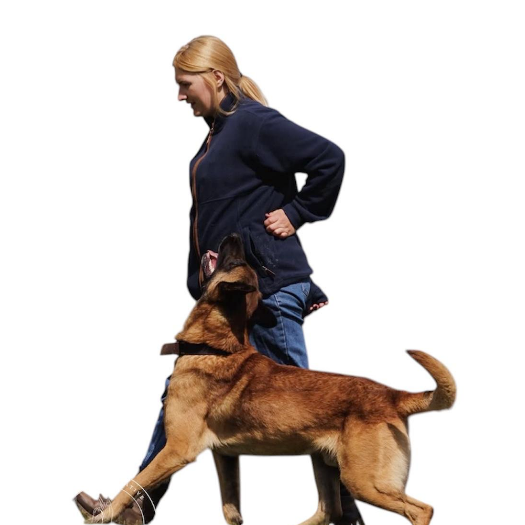
Fitz, our founder and head trainer, earned a degree in Canine Behaviour and Training from the University of Hull in 2008 whilst still serving in the RAF. He was the first serving RAF Police NCO to do so. He has been practising as a qualified canine behaviourist ever since. The degree is important, especially as it enhances what is now almost 45 years of professional dog training experience, from qualifying as a Royal Air Force Police dog handler in 1981 to retiring as the Senior Instructor at The Joint Service Dog School, Defence Animal Centre. You simply don’t get to hold this appointment unless you are exceptional. (Yeah, I know I hardly aged a bit.)
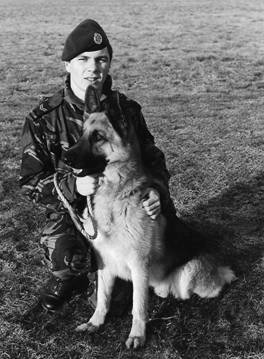
Acting Cpl with Air Dog Ben
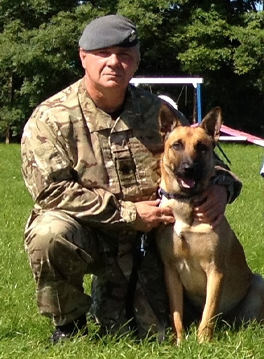
Warrant Officer with Jimmy
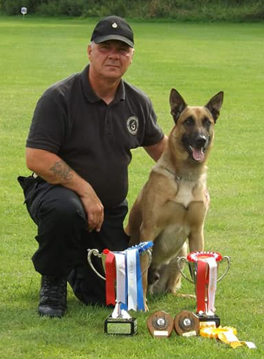
With Jimmy, British Police and Services Reserve Champion 2013 & 2014. Champion 2015 & 2016
Fitz has undertaken additional high-level academic studies and specialises in separation anxiety in dogs and noise phobias in dogs. Separation Anxiety and noise phobia programmes can be conducted with clients remotely and generally involve a period of 3 to 4 months. Changing the underlying emotion of a behaviour takes time. It’s not achieved by waving a magic wand or hurting the dog. He is acknowledged as a Canine Behaviour Practitioner with the Canine and Feline Behaviour Association (CFBA)
About Lydia
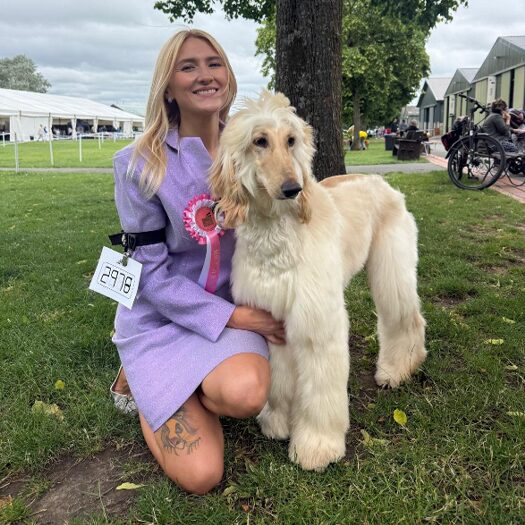
Lydia Harrison RVN, BSc (Hons), MSc, has been training dogs in obedience, working trials and for film and TV work for almost 20 years. She is also a qualified Veterinary Nurse and is a Member of the Royal College of Veterinary Nursing.
Whilst acting as a behaviour specialist for one of the largest chains of veterinary practices in the country, she decided to specialise further and returned to university to complete an MSc in Applied Animal Behaviour and Training. Lydia conducts behaviour modification in all areas of dog and cat behaviour and specialises in compulsive behaviour disorders in both dogs and cats.
She has a particular interest in behaviour modification relating to Dachshunds and sighthounds.

How We Conduct Behaviour Modification
Change the Emotion, Change the Behaviour
At Cosford Dog Training, we are proud of our credentials. Our experience, qualifications and achievements have been hard-earned over many years. You and your dog can benefit from our knowledge and expertise.
We encourage you to compare us with others in the behavioural and training field when choosing the team to support you and your dog.
Your dog is not displaying behavioural problems just for the hell of it. He’s not just being an idiot. He’s struggling with a genuine problem that he can't deal with.
At Cosford Dog Training, we aim to change your dog’s behaviour by changing your dog's emotional response to a given situation and providing him with a different outcome. When the outcome in that situation changes, so does the dog's behaviour. (That’s a bit sciency, but behaviour is a bit sciency, unless you're not a behaviourist.)
Of course, you can often suppress an undesired behaviour through punishment and aversive tools; I did so for many years. But the problem with that approach was, and still is, that the dog still feels the same way about the issue; he just wants to avoid a painful experience… until he doesn’t!
Suppressing the behaviour through punishment or fear of punishment is simply putting a band-aid over a gaping wound or taking the batteries out of your smoke alarm.
We aim for a lifelong fix, not short-term tricks!
01
Behavioural Consultations
For dogs with behavioural problems, the starting point is invariably a home visit to see the dog in its natural environment. This is where the dog generally displays the problem behaviour and is therefore usually the most appropriate place to see it in all its glory. We cannot accurately assess a problem behaviour over the telephone or in an artificial environment. Others may claim they can do it, but we can’t, so we don’t make misleading claims. The initial consultation will generally take between two and two and a half hours. During this time, the dog is observed in the circumstances when it displays the problem behaviour. Wherever the problem manifests itself, that’s where the consultation takes place. This is sometimes inconvenient, but it is effective.
In most cases, the owner is supplied with a full, detailed written report within seven days. This can be sent via the post or, more commonly, via e-mail. This report is written by the behaviourist who carried out the assessment and is specific to you and your dog. It is not a generic printed leaflet.
The report is supported by practical behaviour modification training sessions with you and your dog. You are not left to get on with it.
02
Ongoing Behavioural Support
The comprehensive behavioural report is the only starting point for the programme. It is essential that close contact is maintained between us so that the programme can be amended as progress occurs. This is the owner's responsibility. You must practise between sessions and provide regular feedback as specified in the report. The behaviour modification report is a living document which needs to be amended as we move forward with the dog.
03
Dog-to-Dog and Dog-to-Human Aggression
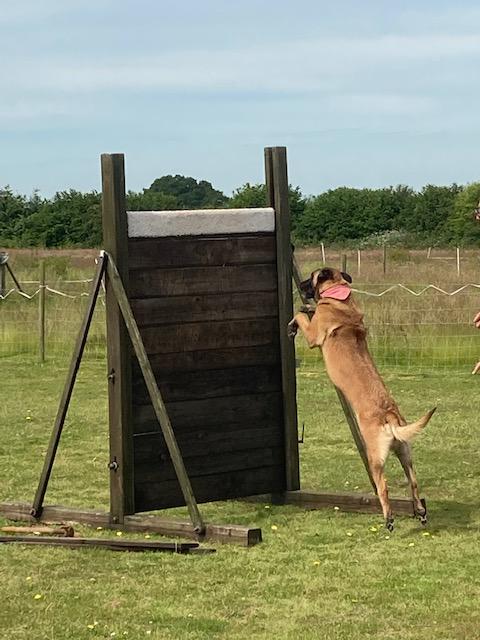
For dogs with most types of aggression issues, the work following the consultation is carried out at Cosford Dog Training in a safe environment, with trained staff and trained dogs to help achieve the desired outcome.
You will work only in public areas once sufficient progress has been made. You are not left to your own devices but are supported throughout. I believe that we are the only establishment offering this level of service and facilities in the Midlands. Behaviour modification takes time and commitment. Unless you have both to put into your dog, we cannot help you. A programme typically lasts at least 3 months. If you contact a “trainer” who claims he can fix your dog’s behavioural issues quickly, as many do, listen very carefully; that jingling sound you can hear in the background are their spurs, as commonly worn by cowboys!
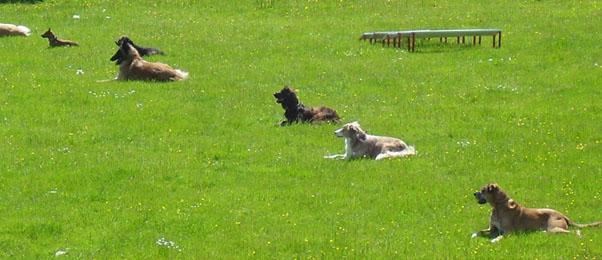
You might be interested in the photo above. This shows Mara, 2nd from the right, performing a 10-minute stay at a Working Trial 70 miles from home, in a place she has never been before, in the company of about 10 dogs she has never previously met.
Mara was a rescue dog from Ireland and had serious dog-to-dog aggression issues, chased traffic and barked incessantly. Her success is due to the hard work put in by her new owners, with support and guidance from our behaviour modification programme and training classes. Mara finished in second place in the trial. (Not bad eh?)